Introducing AIOS: AI-Driven Open Science – a new Erasmus+ curriculum By Paolo Ciancarini, Marcello Missiroli, Giancarlo Succi (Unibo)
19/10/2026Prof. Panos Fitsilis, University of Thessaly fitsilis@uth.gr
AI is reshaping the work of IT and ICT professionals and giving rise to entirely new professional roles. To help organisations, educators and practitioners navigate these changes consistently, CWA 18398:2026, AI Professional Role Profiles and Educational Profiles, offers a shared reference for describing the new roles. Note that it is a European Committee for Standardization (CEN) Workshop Agreement, not a binding European standard, so it guides practice rather than mandating it.
The CWA defines 37 AI professional role profiles. Each one sets out a mission, typical tasks and deliverables, the relevant e-CF competences, the AI-specific knowledge needed, and the personal and interpersonal skills the role calls for. The CWA also offers educational profiles, which turn those role requirements into learning outcomes and assessment methods. Because a single role can map to several educational profiles, depending on the knowledge, experience and level of responsibility involved, the framework can serve people at different stages of their careers (CEN, 2026).
The CWA distinguishes AI professionals from professionals who use AI in their work. AI professionals plan, develop, operate, manage, or govern AI systems. Professional users apply AI within a sector or occupation but do not necessarily develop the underlying technology.
AI bilingualism concerns this second group. Because professional users are not defined by building AI, what they need is a competence rather than a role profile. AI bilingualism is therefore not a classification of AI occupations. It is the competence to connect domain expertise with an informed understanding of AI. AI-bilingual professionals can communicate organizational needs to AI specialists, use AI systems effectively, and interpret their outputs in context. They also apply human judgement, verify AI outputs, and retain responsibility for final decisions (Fitsilis, 2026a; Fitsilis, 2026b). This emphasis on combining AI knowledge, practical application, ethical judgement, and human agency is also reflected in UNESCO’s AI competency frameworks for teachers and students (Miao & Cukurova, 2024; Miao et al., 2024).
CWA 18398:2026 builds on the European e-Competence Framework, the European ICT Professional Role Profiles, and the European guidelines for ICT curricula. It organizes the 37 profiles into seven role families:
- Data Processing and Analysis: It includes roles which collect, prepare, manage, and analyse data and transform it into training material for AI systems.
- Development: Refers to roles that have as responsibilities to design, develop, integrate, test, and validate AI systems.
- Operations: Roles that deploy, operate, monitor, and maintain AI systems in operational environments. The role of AI Platform Engineer belongs to both Development and Operations.
- Support: Roles that provide technical, security, service, and user support after an AI system has been deployed.
- Guidance: Roles that provide ethical, legal, educational, and human-centred guidance for AI development and use. This role family is consistent with UNESCO’s human-centred approach to AI ethics and with its competency frameworks for teachers and students (UNESCO, 2021; Miao & Cukurova, 2024; Miao et al., 2024).
- Management: Includes roles that direct AI strategy, organizational change, projects, products, teams, and resources.
- Governance: Roles responsible for oversight, risk management, auditing, regulatory compliance, and organizational controls.
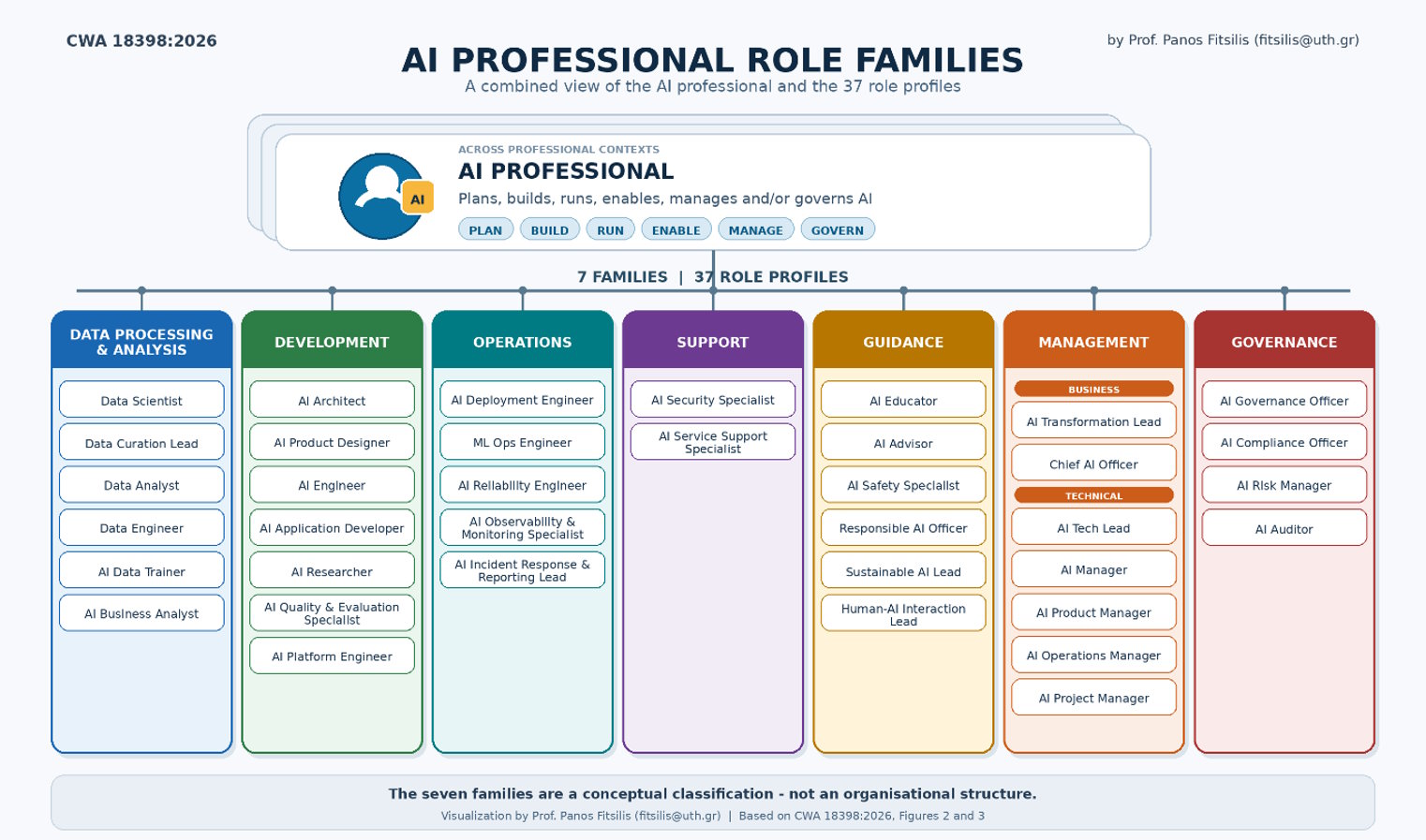
For example, representative roles are: Data Scientist, AI Architect, AI Engineer, MLOps Engineer, AI Educator, Chief AI Officer, and AI Compliance Officer. Together, the seven families cover the main stages of the AI-system lifecycle described by the OECD: planning, data preparation, model development, verification, deployment, operation, and monitoring (OECD, 2022).
The seven families give organisations a sound way to classify AI jobs, but they are not meant as an organisational chart. A company does not need 37 separate people to cover 37 profiles. For example, in smaller organizations, one person may perform several roles. In larger organizations, the responsibilities of one role may be distributed across several employees or teams.
The CWA can help organisations with workforce planning, recruitment, competence assessment, professional development and curriculum design. It is also relevant to a legal duty many of them already have. Under Article 4 of the EU AI Act, providers and deployers of AI systems must take measures, to the best of their ability, to ensure that their staff, and anyone else using AI systems on their behalf, have a sufficient level of AI literacy. This relates to employee’s knowledge, experience and training, the context in which they work, and who might be affected by the AI system (Regulation (EU) 2024/1689, 2024).
AI literacy, however, does not cover the full range of organisational needs. Organisations also require professionals who can connect AI technology with business and sector needs. This calls for a combination of technical knowledge, domain knowledge, ethical awareness, human oversight and accountability, referred to here as AI bilingualism. The CWA defines the roles needed to plan, develop, operate, manage or govern AI systems, while the AI Bilingualism Competence Architecture defines the human competences needed to connect these systems with domain knowledge and organisational decision-making.
References
- European Committee for Standardization. (2026). AI professional role profiles and educational profiles (CWA 18398:2026). CEN-CENELEC Management Centre. https://www.cencenelec.eu/media/CEN-CENELEC/CWAs/RI/2026/cwa18398_2026.pdf
- Fitsilis, P. (2026a). From AI literacy to AI bilingualism: A competence framework for domain–AI integration in the workforce [Technical Report]. MANDEIS Research Lab, University of Thessaly. DOI: 10.13140/RG.2.2.24495.70564
- Fitsilis, P. (2026b). The AI Competence Framework Landscape: A Comparative Analysis of Frameworks for Education and Workforce Development. https://doi.org/10.35542/osf.io/ygr6n_v2
- Miao, F., Cukurova, M., & UNESCO. (2024). AI competency framework for teachers. UNESCO. https://unesdoc.unesco.org/ark:/48223/pf0000391104
- Miao, F., Shiohira, K., Lao, N., & UNESCO. (2024). AI competency framework for students. UNESCO. https://unesdoc.unesco.org/ark:/48223/pf0000391105
- Organisation for Economic Co-operation and Development. (2022). OECD framework for the classification of AI systems (OECD Digital Economy Papers No. 323). OECD Publishing. https://doi.org/10.1787/cb6d9eca-en
- Regulation (EU) 2024/1689 of the European Parliament and of the Council of 13 June 2024 laying down harmonised rules on artificial intelligence (Artificial Intelligence Act). (2024). Official Journal of the European Union, L, 2024/1689. https://eur-lex.europa.eu/eli/reg/2024/1689/oj
- United Nations Educational, Scientific and Cultural Organization. (2021). Recommendation on the ethics of artificial intelligence. UNESCO. https://unesdoc.unesco.org/ark:/48223/pf0000380455